- The Bridge
- Posts
- The Hidden Costs Of Operating At Partial Capacity
The Hidden Costs Of Operating At Partial Capacity
Why Most Founders Fail To Achieve Success
Read time: 4 min
Welcome to Agua, a weekly newsletter where I provide tactics and stories to help founders magnify their potential.
Today’s Top Takeaways:
Being fully present is essential for making informed decisions, building strong relationships, and driving results. A lack of presence can lead to missed opportunities, ineffective decision-making, and strained relationships.
To cultivate a strong sense of presence, you can prioritize nonjudgmental awareness, limit distractions, and actively engage in activities that require full attention.
Three tips to be more present and increase your capacity include incorporating a daily meditation practice, practicing nonjudgmental awareness by observing thoughts and emotions without judgment or criticism and limiting distractions by scheduling deep work, and eliminating interruptions during work time.
The Hidden Costs Of Operating At Partial Capacity
Why Most Founders Fail To Achieve Success

via Wikipedia
The truth is, you’re likely only operating at a fraction of your full potential – and it's all because of a lack of presence.
When you are fully present, you are better equipped to make informed decisions, build strong relationships with your team, and drive results. On the opposite end of the spectrum, when you are distracted or operating at partial capacity, you can miss important cues, struggle to connect with others and make decisions based on incomplete information.
Because of the fast-paced nature of our world coupled with the constant barrage of distractions and the need to always be on, it’s more difficult than ever to fully be present. Due to this partial capacity, the struggle to balance work demands with personal needs is turned into a norm, leading to constant burnout and overwhelm.
A lack of awareness and engagement in the present moment is a major barrier to success leading to missed opportunities, ineffective decision-making, and strained relationships. However, by prioritizing nonjudgmental awareness, limiting distractions, and actively engaging in activities that require full attention, you can cultivate a strong sense of presence and unlock your full potential to drive success in your career.
Here are 3 tips to get started:
Prioritize Daily Meditation
By now you’re familiar with the benefits of meditation, so I’m not going to dive into that. Rather, I’ll share my story.
I’ve been meditating daily for 6 years, on and off for 8 years, am a certified meditation teacher, have spent over a month in extended silence, and since the end of Dec ‘22, have been meditating at least an hour a day.
You’re likely thinking in your head, who has time for that when building a company and balancing all the other demands of life?
This is where the capacity piece comes in. Since meditating daily, my capacity has exponentially grown. I can do more with way less time because my mind isn’t down the street, it’s right here, in the present moment, writing this newsletter, being here with you, and in the most effective way, I possibly can.
If you’re not sure how to integrate a meditation practice, my big shift was adding time to my calendar.
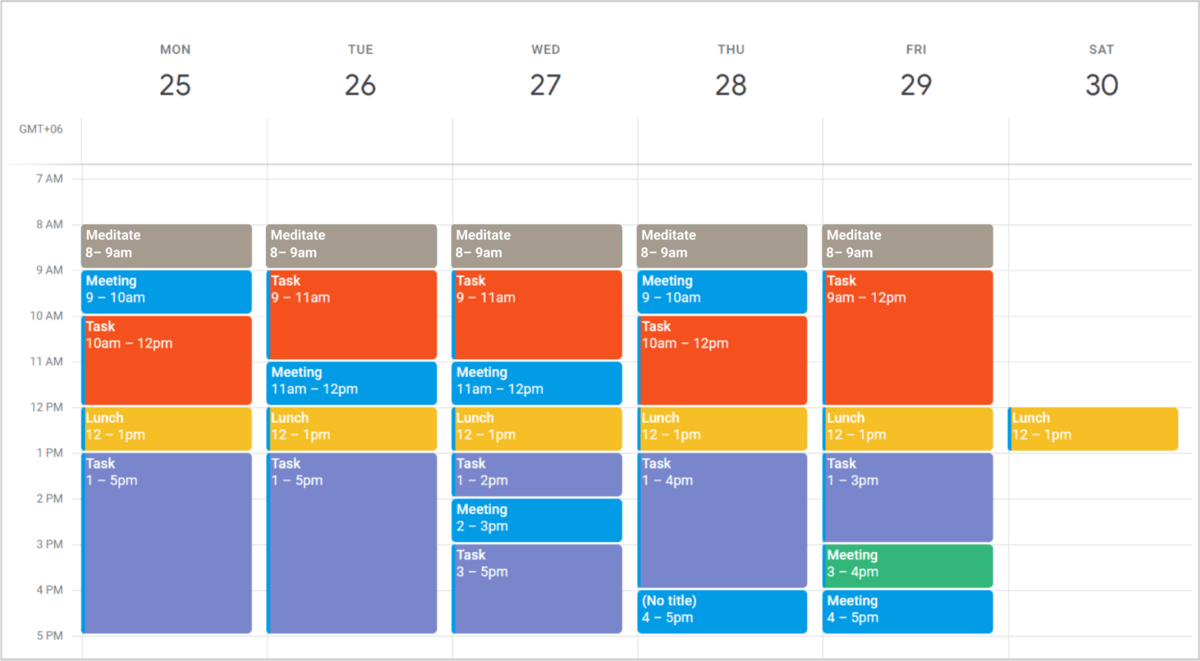
Experiment with adding time in the morning, right after you wake up. If you’re feeling extra inspired, test out adding another slot in the afternoon right when you’d usually go for your afternoon coffee.
If you’re still not sold on prioritizing daily meditation, listen to Huberman on why you must meditate every day.
Nonjudgmental Awareness
The aim of meditation is to bring awareness-based skills into your everyday life. This is where nonjudgmental awareness comes in. The core of this concept is to notice without judgment. The aim here has both inner and outer advantages.
Inner
Practice observing your thoughts, feelings, and bodily sensations without judgment or criticism. When you can step back from your thoughts and emotions, you can observe them objectively rather than being fully consumed by them. This shift in perspective can lead to greater insight and make more informed decisions.
For example, if you’re feeling overwhelmed by a heavy workload, stepping back and observing your emotions and feelings can help you identify the root cause of your stress. This can then inform a more effective decision and help you prioritize your workload in a more strategic manner.
Outer
All day you’re taking in information. Whether it be through reading, like right now, listening to what’s around you, or when chatting with someone, being able to best consume information, orient it effectively, and shift it into insight is a superpower– especially when done as timely as possible. You can then better pick up on important cues and respond to the needs of your team.
For example, if someone is feeling frustrated, if you’re fully present and engaged, you can more likely to pick up on this and address the issue, leading to a more positive outcome.
Limit Distractions
Your time is your most precious resource. Yet, most have their mind elsewhere, are addicted to the dopamine of notifications, or don’t have the ability to set boundaries to prioritize heads-down time.
Throughout my career, I have discovered & rediscovered a simple truth. It is this: the ability to concentrate single-mindedly on your most important task, to do it well & to finish it completely, is the key to great success, #achieve#achievementt, status & happiness in life.
— Brian Tracy (@BrianTracy)
11:05 PM • Dec 30, 2019
A couple of ways you can do this is from the book Deep Work, by Cal Newport.
Cal shares that you should schedule deep work into your calendar like any other important task. By dedicating specific blocks of time to focus, and uninterrupted work, leaders can prioritize their most important tasks and achieve their goals. This can be anywhere from 30 min - 2hrs a day.
Then, during this time, eliminate distractions. This can involve turning off notifications, disconnecting from the internet, or finding a quiet place to work. By minimizing distractions, you can fully engage in your work and achieve a state of flow.
Your ability to stay present is a major barrier to your success. Prioritize meditation, practice nonjudgmental awareness, and limit distractions to increase your capacity.
See you next week,
Rachel
Whenever you’re ready, here are 3 ways I can help you:
CEO Coaching: CEO coaching for high-growth founders. I work with top CEOs and founders to unleash their superpowers, surpass their goals, and thrive in the process while scaling their companies. Learn more here.
Self-Paced Courses: Learn proven strategies, systems, and tactics to perform at your best, maximize your potential, and achieve lasting results. Check out Master Your Inner Game and Magnify Your Potential Masterclass.
Speaking: Inspire and motivate your organization with the power of creativity, decision-making, productivity, innovation, leadership, and mindfulness. Get in touch here.

If you enjoyed today's newsletter, please share it with a founder in your life who’d find it valuable. And, if this email was forwarded to you, consider subscribing to receive them in the future!